Market Entry into Germany – Tax and Legal Essentials for Foreign Businesses
Employees, branch or corporation – how foreign companies can enter the German market without tax surprises
By Andreas Lang –
Germany is Europe’s largest economy and, for many of our international clients, the first step into the EU market. Market entry often starts small: a sales manager working from home, a team of technicians on a customer’s site, or a first local office.
What looks like a simple business decision can create a German permanent establishment, payroll and social security obligations, and VAT registrations, often without the foreign company noticing it.
Here is what you and your clients need to know before the first employee starts working in Germany.
1. Overview: Three Typical Entry Routes
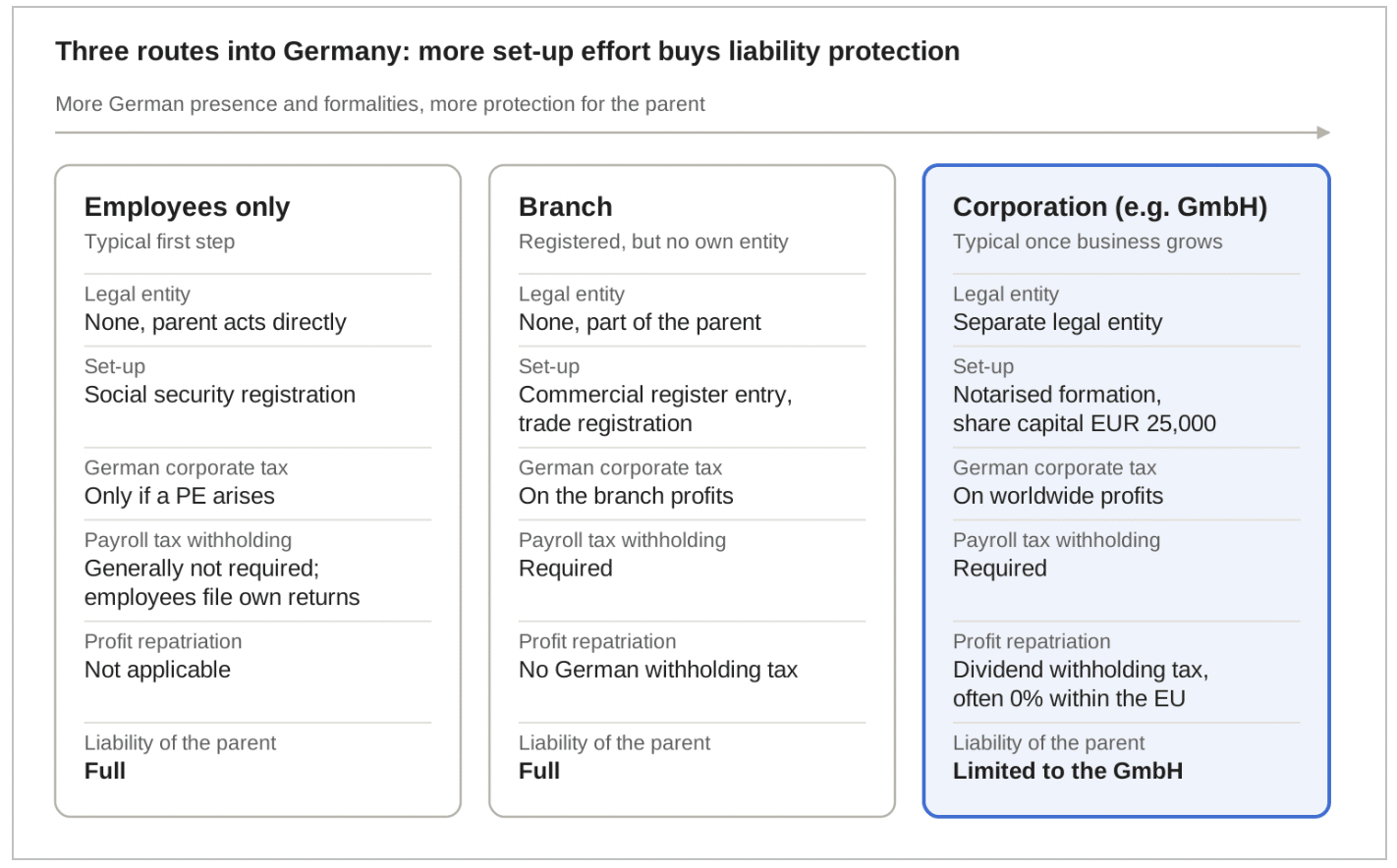
In practice, many clients start with employees only and set up a GmbH once business grows. The transition should be planned, because a permanent establishment may already exist before the GmbH is founded.
2. The Permanent Establishment Trap
A permanent establishment (PE) makes the foreign company subject to German corporate income tax and trade tax on the profits attributable to its German activities. The most common triggers are:
Home offices: A home office of an employee can constitute a PE if the employer has sufficient power of disposal over it and it is used regularly for the business. Mere work from home or reimbursement of costs is generally not sufficient. The risk is particularly relevant where key management decisions are taken from the home office.
Dependent agents: Employees or agents who habitually conclude contracts in Germany on behalf of the foreign company, or who play the principal role in concluding them, can create an agency PE even without any office.
Construction and installation projects: Under German domestic law, a site lasting more than six months is a PE. Most treaties raise the threshold to twelve months. Several simultaneous or uninterrupted consecutive projects may be aggregated under German domestic law.
Place of management: If the key management decisions of the foreign company are actually taken in Germany, the company may even become fully taxable in Germany.
A PE requires a German tax registration, annual tax returns and an arm’s length profit attribution. If it is discovered only in a tax audit, back taxes plus interest of 1.8% per year can quickly add up. A clear definition of tasks and authority in the employment contract, aligned with actual conduct, is an important safeguard.
3. Corporate Taxation in Germany
The total tax burden of a German GmbH or branch currently amounts to about 30%:
Corporate income tax: 15%, plus a solidarity surcharge of 5.5% on the tax, i.e. 15.825% in total.
Trade tax: 3.5% multiplied by the municipal multiplier, which ranges from 200% to over 500%. In Stuttgart (420%) this results in 14.7%, in Munich (490%) 17.15%.
Good news ahead: The corporate income tax rate will fall by one percentage point per year from 2028 until it reaches 10% in 2032. The overall burden in a large city will then fall to roughly 25%.
Further points to consider:
For a German GmbH, dividends to the foreign parent are subject to 26.375% withholding tax. Under the EU Parent-Subsidiary Directive or a treaty, this can be reduced, often to 0% or 5%. Germany’s anti-treaty-shopping rule requires real economic substance at the parent company.
Interest barrier: Net interest expense above EUR 3 million is deductible only up to 30% of tax EBITDA.
Losses can be carried forward without time limit, but their use is restricted above EUR 1 million per year, and they may be forfeited if more than 50% of the shares are transferred.
4. Employing Staff in Germany
Payroll tax. A foreign employer without a German PE or permanent representative is generally not obliged to withhold German wage tax. The employee must then file a German income tax return and make quarterly advance payments. This is often a burden for the employee and should be addressed in the employment contract. Once the foreign employer has a German branch, PE , monthly wage tax withholding for the employer is mandatory.
Social security. As a general rule, German social security applies to employees working in Germany, even for a foreign employer without any German presence. The foreign employer must register with the German authorities and pay the employer’s share of roughly 21% of gross salary (up to the contribution ceilings), with certain levies and accident insurance contributions potentially applying in addition. Exceptions may apply, in particular, to posted employees who remain subject to their home-country system and hold an A1 certificate (EU/EEA/Switzerland, generally up to 24 months if the posting conditions are met) or the relevant certificate under a bilateral social security agreement.
Employment law. The statutory minimum wage is EUR 13.90 per hour in 2026 and rises to EUR 14.60 on 1 January 2027. German employment law offers strong dismissal protection after six months of employment in businesses with more than ten employees. Written proof of the essential terms of employment is mandatory.
Employer of Record (EoR). Engaging staff via an EoR provider can be a fast interim solution. However, it does not automatically remove the PE risk, and the German rules on temporary agency work must be observed.
5. VAT, E-Invoicing and Transfer Pricing
VAT. The standard VAT rate is 19% (7% reduced rate). B2B services to German customers are generally subject to the reverse charge mechanism, so a foreign supplier often does not need a German VAT registration. A registration may be required, however, in particular for local supplies of goods and for B2C transactions not covered by the One-Stop-Shop.
Mandatory e-invoicing. Since 1 January 2025, all businesses established in Germany must be able to receive structured e-invoices (XRechnung, ZUGFeRD). From 1 January 2027, businesses with a prior-year turnover above EUR 800,000 must issue e-invoices for domestic B2B supplies; from 2028, this applies to all. A German GmbH or branch falls under these rules. Foreign companies that are merely VAT-registered in Germany are generally excluded.
Transfer pricing. Intercompany services, licenses and financing between a Germana entity (or PE) and it foreign related parties must be at arm’s length. Since 2025, German tax authorities can request transfer pricing records, including the transaction matrix, within 30 days. In a tax audit, the transaction matrix and, where applicable, the master file must generally be submitted within 30 days of the audit order without a separate request. For branches, profits must be attributed under the Authorized OECD Approach.
Set-up checklist for a German GmbH:
Choose the location: the trade tax multiplier differs considerably between municipalities.
Notarize the articles of association and pay in at least EUR 12,500 of the share capital.
Register with the commercial register and the Transparency Register.
Register the business with the municipality and with the tax office (ELSTER), and apply for a VAT ID.
Register as an employer for social security and set up payroll.
Conclude intercompany agreements before the first services are rendered.
Set up German GAAP bookkeeping; annual accounts must be disclosed or filed with the company register, as applicable.
6. Conclusion
Entering the German market does not have to be complicated, but it should be planned. The key question is not only which legal form to choose, but also which German obligations already arise from the very first employee or project. Clear contracts, early registrations and a well-timed switch to a German GmbH avoid costly surprises in a later tax audit.
If your clients are planning to do business in Germany, reach out to us. We support foreign companies from structuring and registration to payroll, bookkeeping and annual tax compliance.
Andreas Lang
Senior Manager | Dipl.-Ökonom
Schlecht und Partner / Boorberg Schlecht und Collegen Steuerberatungsgesellschaft mbH
Stuttgart · Munich · Nuremberg, Germany
a.lang@schlecht-partner.de · www.schlecht-partner.de
October 2026
This article reflects the legal position as of October 2026 and does not replace individual advice.