Acquiring a German Business – Tax Issues to Consider
Asset deal or share deal – why the transaction structure decides the tax bill on both sides of the table
By Dr. Benjamin S. Cortez – Steuerberater (German Certified Tax Advisor), Certified Advisor for International Tax Law, MBA (International Taxation)
German Mittelstand companies remain attractive targets for international strategic buyers, family offices and private equity investors. Many of these businesses are owner-managed, and a growing number are looking for a successor.
When a foreign buyer acquires a German business, one of the first questions is whether to buy the assets or the shares. The answer has a major impact on the purchase price, future depreciation, the use of tax losses and the historic tax risks the buyer takes over. Buyers and sellers usually have opposing interests here.
Here is what foreign buyers and their advisors need to know before signing a letter of intent for a German target, with practical tips from our transaction practice.
1. Overview: Asset Deal vs. Share Deal
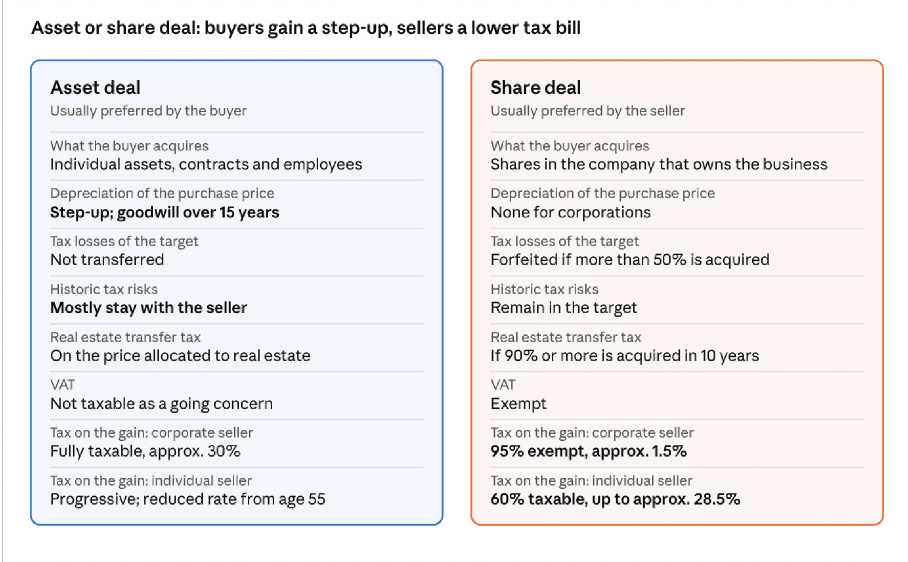
The bold entries mark the decisive advantage for each side. For partnerships, the purchase of interests is treated like an asset deal for the buyer (see section 3).
2. Asset Deal: The Buyer’s Preferred Route
In an asset deal, the buyer acquires the individual assets and liabilities of the business. From a tax perspective, this is usually the more attractive structure for the buyer.
Step-up and depreciation: The purchase price is allocated to the acquired assets at their fair values. The difference between book values and purchase price creates new depreciation potential. Goodwill is amortised over 15 years for tax purposes, buildings generally over 33 to 50 years, and movable assets over their useful lives. Movable assets acquired until the end of 2027 can be depreciated at up to 30% per year on a declining-balance basis. A well-documented purchase price allocation is therefore essential.
Clean start: Historic tax risks generally remain with the seller. However, the buyer is liable under German law for business-related taxes and tax withholding amounts that arose since the beginning of the calendar year preceding the transfer, provided they are assessed or declared within the statutory one-year period, with liability limited to the acquired assets.
VAT: The transfer of a business as a going concern is not subject to VAT. Partial transfers must be carefully structured, as VAT of 19% could otherwise be charged.
Real estate transfer tax: If real estate is part of the deal, RETT of 3.5% to 6.5% applies to the price allocated to it.
Employees and contracts: Employment relationships transfer automatically to the buyer by law. Customer and supplier contracts, permits and licences generally require consent of the counterparty or new applications.
The main drawbacks are practical: each asset and contract must be transferred individually, and tax losses of the target cannot be taken over.
Tip for foreign buyers: Do not acquire the assets directly from abroad. A newly formed German acquisition company avoids a German permanent establishment of the foreign parent with its own filing duties, ring-fences the German business and keeps a later exit by share sale open. Agree the purchase price allocation in the contract, ideally supported by a valuation, to reduce disputes with the tax auditor. Also check early whether new VAT registrations, customs or excise permits are needed for the acquired business.
3. Share Deal: Simpler Transfer, Inherited Risks
In a share deal, the buyer acquires the shares in the target company that owns the business. The legal transfer is simple, contracts and permits generally stay in place, but the tax consequences compared to an Asset Deal differ fundamentally.
No step-up for corporations: If the target is a GmbH or AG, the purchase price is booked as the cost of the shares. It cannot be depreciated, and the hidden reserves in the target remain taxable at company level.
Acquisition financing: Interest on acquisition debt taken up by a German acquisition company can only be offset against the target’s profits if a fiscal unity (Organschaft) is established. This requires a profit and loss transfer agreement with a minimum term of five years. Alternatively, a merger of the acquisition company into the target can achieve a similar result. The interest barrier applies to net interest expense above EUR 3 million.
Loss forfeiture: Tax losses and interest carry-forwards of the target are forfeited if more than 50% of the shares are transferred to one buyer within five years. Exceptions apply for intra-group restructurings, to the extent of taxable hidden reserves, and on application if the business continues unchanged.
Real estate transfer tax: If the target owns German real estate, RETT may be triggered, in particular if at least 90% of the shares are transferred to new shareholders within ten years or are combined in one acquirer’s hands.
Historic tax risks: All tax liabilities of the past remain with the target and therefore economically with the buyer. Tax assessments can generally be amended for four years, and for up to ten years in cases of tax evasion.
Special case: partnerships. If the target is a partnership, for example a GmbH & Co. KG, German tax law treats the purchase of the partnership interests like an asset deal. The buyer can create a step-up in a supplementary tax balance sheet and amortise the goodwill over 15 years. Trade tax losses, however, are lost to the extent the partners change.
Tip for foreign buyers: A foreign buyer who acquires partnership interests directly becomes a partner of a German business and is itself subject to German tax filing obligations. Interposing a corporation can ring-fence these obligations at the level of the acquisition vehicle. US buyers should also look at the US tax classification of the target: a GmbH can generally elect to be treated as a disregarded entity or partnership for US purposes, which can create a step-up for US tax purposes even in a share deal.
4. Structuring the Acquisition as a Foreign Buyer
The acquisition structure decides how efficiently profits can be repatriated and how the investment can be sold later. Foreign buyers and their advisors should address the following points before signing:
Acquisition vehicle: A German acquisition company (BidCo) allows the acquisition financing to be offset against the target’s profits through a fiscal unity. The foreign holding company above it should be chosen with substance in mind: dividends from Germany are subject to 26.375% withholding tax, which may be reduced under the EU Parent-Subsidiary Directive or a treaty, subject in particular to the applicable anti-treaty-shopping requirements.
Plan the exit now: Germany can tax gains of non-resident shareholders holding at least 1% in a German corporation. Most treaties allocate this right to the seller’s state of residence, but not for companies whose value derives mainly from German real estate. The location of the holding company therefore also determines the tax on a later exit.
Shareholder loans: Intragroup financing must be at arm’s length. German transfer pricing rules require that the borrower could have obtained and serviced the debt from a third party. For trade tax purposes, 25% of financing expenses above EUR 200,000 are added back. Anti-hybrid rules deny the interest deduction if the corresponding income is not taxed at the lender.
Foreign investment control: Depending on the sector, acquisitions reaching 10% or 20% by non-EU/EFTA buyers in sensitive sectors such as critical infrastructure or certain technologies must be notified to the Federal Ministry for Economic Affairs; certain defence-related acquisitions by non-German buyers are subject to a 10% threshold. Closing is prohibited until clearance where a mandatory filing applies. Acquisitions of 25% or more by non-EU/EFTA buyers in other sectors can be reviewed as well. The German rules are currently being reformed, so the clearance should be built into the timetable and the purchase agreement as a closing condition.
Formalities: The transfer of GmbH shares requires a notarial deed. Deeds may be executed in English if the notary and the parties have sufficient command of the language; otherwise, an interpreter may be required. Foreign buyers can be represented by attorneys, with the form and any apostille or legalisation requirements for the power of attorney depending on the circumstances and country of origin. After closing, the shareholder list and, where required, the Transparency Register must be updated.
Global minimum tax: Groups with consolidated revenue of EUR 750 million or more should check how the German target fits into their Pillar Two calculation, especially where low-taxed holding companies are used.
5. The Seller’s View and How to Bridge the Gap
Sellers usually prefer a share deal, because Germany taxes the sale of shares favourably:
Corporate sellers benefit from a 95% exemption on gains from the sale of shares in a corporation. The effective tax burden is only about 1.5%. In an asset deal, the gain is fully taxable at roughly 30% at the level of the selling company, and a further tax charge arises when the proceeds are distributed.
Individual sellers pay tax on only 60% of a share sale gain if they hold at least 1% (partial income method), resulting in an effective rate of up to approximately 28.5%. Gains from the sale of a sole proprietorship or partnership interest are taxed at progressive rates, but sellers aged 55 or older can claim a reduced rate once in their lifetime.
The opposing interests are usually resolved through the purchase price: a buyer who receives a valuable step-up in an asset deal can pay more, while a share deal often justifies a discount for the inherited risks and the missing depreciation. Calculating the net present value of the tax benefits for both sides helps to find a fair compromise.
Pre-sale restructurings can combine the advantages of both structures, for example converting the target into a partnership or hiving down the business into a new GmbH. These options are subject to holding periods and anti-abuse rules. A sale within seven years after a contribution of a business into a corporation, for instance, can retroactively trigger taxation of the hidden reserves. Such steps should therefore be planned well before the sale process starts.
Earn-outs and vendor loans affect the timing of the seller’s taxation and should be reflected in the purchase agreement from a tax perspective as well.
Tip for advisors on the buy side: Find out early whether the seller is an individual or a corporation and how long the shares have been held. This tells you how strongly the seller will resist an asset deal and how much purchase price headroom a step-up must create. If the seller has restructured in recent years, request the documents on holding periods before agreeing on the deal structure.
6. Tax Due Diligence and Protection in the Purchase Agreement
Especially in a share deal, a tax due diligence is indispensable. In owner-managed German companies, we regularly find the following red flags:
Hidden profit distributions: shareholder salaries, rents, loans or company cars at non-arm’s-length terms.
Payroll and social security: freelancers who are in fact employees, which can trigger back payments of social security contributions for up to four years, or 30 years in cases of intent.
VAT: incorrect invoices, reverse-charge errors or missing input VAT documentation.
Transfer pricing and permanent establishments: cross-border group transactions without documentation, or foreign subsidiaries and offices that were never reported.
Prior restructurings: holding periods from earlier contributions, mergers or spin-offs that the sale could breach.
The findings should be reflected in the share purchase agreement. Typical protection mechanisms are a tax indemnity covering all taxes for periods up to the closing or locked-box date, tax-specific warranties, a long limitation period that ends only after the tax assessments have become final, and the buyer’s right to conduct future tax audits. Warranty and indemnity insurance is increasingly common in German mid-market deals, but known risks are excluded from cover and must be addressed through a specific indemnity or a price adjustment.
Tip for foreign buyers: Tax and accounting records of German targets are usually in German. Plan time for translation and insist on access to the latest tax audit report, which often reveals recurring issues. Make sure an English-language purchase agreement fits German tax concepts: the tax indemnity should expressly cover interest and surcharges under the German Fiscal Code, secondary liabilities and social security contributions, and should run until the relevant assessments are final.
7. Conclusion
The choice between an asset deal and a share deal is one of the most important value drivers in a German acquisition. Buyers benefit from the step-up of an asset deal or of a partnership interest, while sellers prefer the low taxation of a share sale. Early tax structuring, a focused tax due diligence and a well-drafted tax indemnity protect both sides and often create room for a better deal.
If your clients are considering the acquisition of a German business, reach out to us. We support international buyers and their advisors from structuring and tax due diligence to the purchase agreement and post-deal integration, and we are happy to work alongside your team.
Dr. Benjamin S. Cortez
Partner | Steuerberater (German Certified Tax Advisor) | Certified Advisor for International Tax Law | LL.M., MBA (International Taxation)
Schlecht und Partner / Boorberg Schlecht und Collegen Steuerberatungsgesellschaft mbH
Stuttgart · Munich · Nuremberg, Germany
b.cortez@schlecht-partner.de · www.schlecht-partner.de
October 2026
This article reflects the legal position as of October 2026 and does not replace individual advice.